

Bard on the Beach to September 18, 2026
Tickets from $30 at 604-739-0559 or www.bardonthebeach.org
Posted July 14, 2026
Half a lifetime ago, I had to read the Hippolytus for a course in erotic tragedy offered by the late, much-admired Dr. Errol Durbach. I was immediately hooked: I read all of Euripides, most of Sophocles and Aeschylus and a smattering of Aristophanes in translation. And so, I was very curious about how the Bard on the Beach would tackle Antigone twenty-five hundred years after Sophocles inscribed it on a wax tablet, later to be transcribed onto a papyrus scroll.
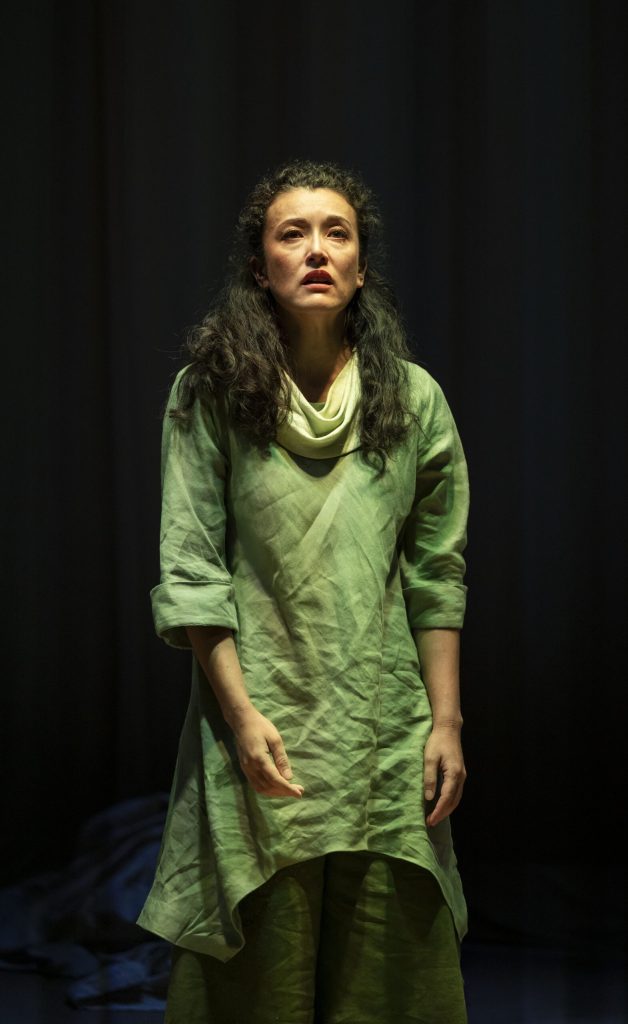
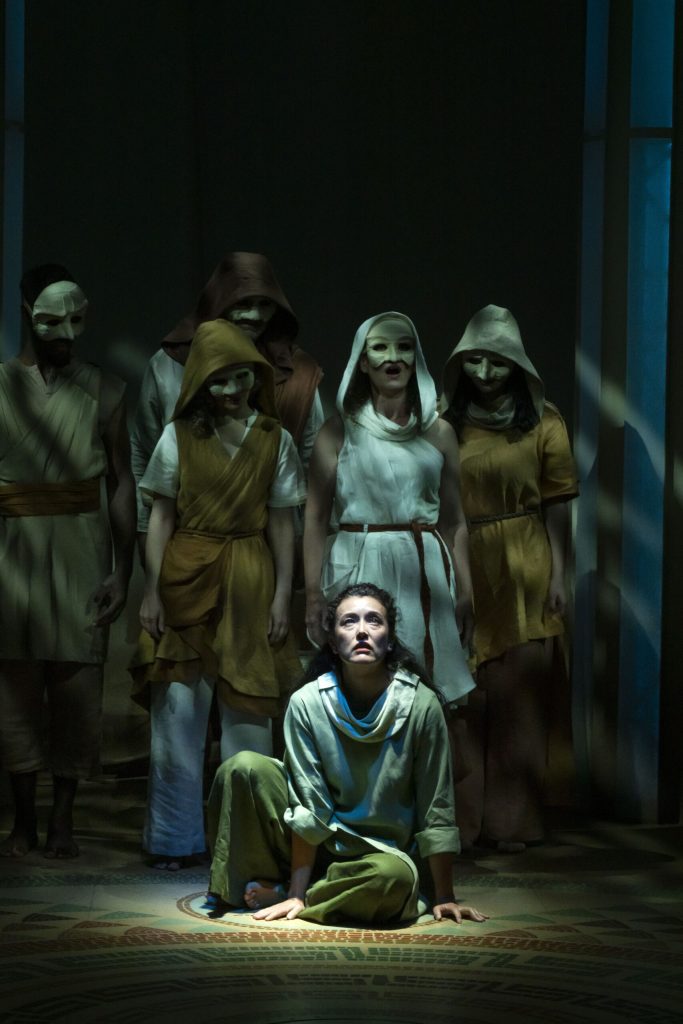
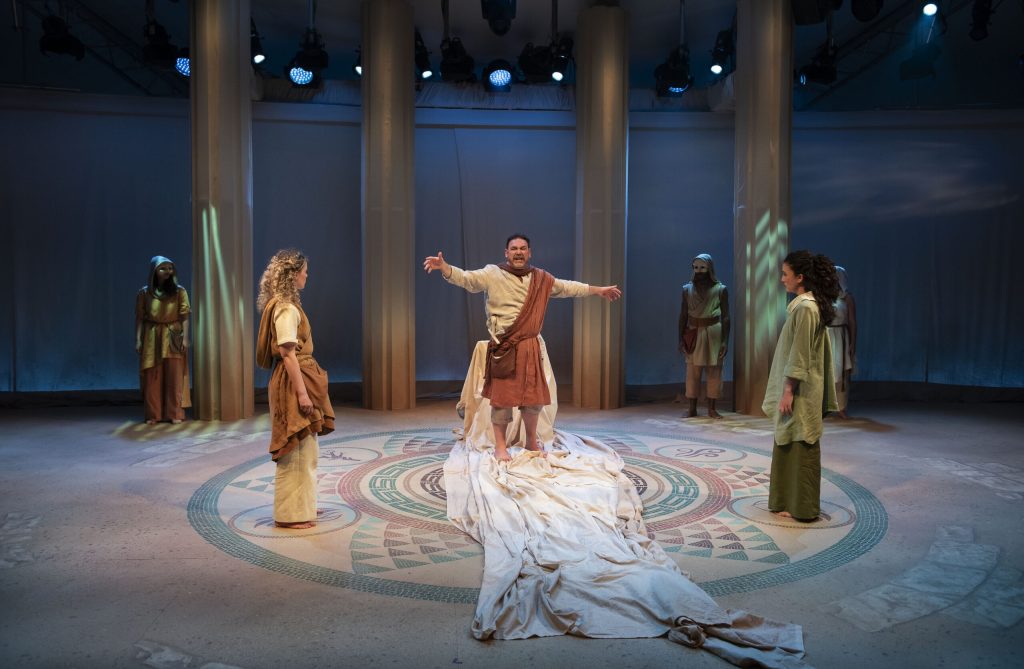
This Bard production was adapted by Kate Besworth and conceived by Besworth and director Ming Hudson. I admired this production – the rustic earth-toned, layered cotton tunics on the Chorus and all the characters except Antigone who is dressed in layers of leafy green (by designer Jessica Oostergo); the exquisite Greek columned set and lighting by John Webber; and the heart-beating soundscape by Joelysa Pankanea – but I missed the political complexity of Sophocles’ great tragedy. There were, however, tears shed in the Douglas Campbell Theatre on opening night so this production clearly affected many.
The story: After King Oedipus of Thebes blinded himself, went into self-imposed exile and later died, the crown passed to his two sons Polynices and Eteocles who agreed to share the throne. Eteocles reneged on the arrangement, war broke out and both brothers were slain, leaving Creon, their uncle, to rule. Deemed by Creon to be the ‘honourable’ brother, Eteocles is given a hero’s burial while Polynices is tossed outside the city walls to be devoured by dogs and birds. Creon passes a law, on pain of death, forbidding Polynices to be buried but Antigone, Polynices’ sister, attempts to cover him with sand, claiming it is against the law of the gods not to give her brother a proper burial. She makes a half-hearted attempt to get her sister Ismene to help but it’s clear, she wants to act alone. Half in love with death, Antigone is on a mission and nothing will stop her. She’s caught and walled up in a cave where she hangs herself. Creon changes his mind, rushes to the cave but he is too late. There he confronts his son Haemon, Antigone’s betrothed, who also kills himself.
Some scholars argue that Antigone hangs herself, not to avoid a long, slow death but that she feels abandoned by her gods, thus proving – to her – that Creon is ‘right’ in enforcing his law, and her position is ‘wrong’.
In this adaptation, Antigone (Yoshie Bancroft) is the focus from beginning to end. (In the original, Antigone disappears about two-thirds of the way through.) Here, it is clearly Antigone’s story although in its original form it is, arguably, Creon’s story: a clash between manmade law and the law of the gods. In this adaptation, Antigone is the doomed heroine and Creon is simply the villain. The play, as we read it way back when, is really less about Antigone and more about the perils of power: when to bend, when to stand firm. When to recognize that hubris has overwhelmed your better judgement.
Here’s an interesting point: in Sophocles’ text, Antigone confesses that she would not disobey the rule had the corpse been a husband or a child of hers: she’s prepared to uphold the gods’ rule, but only for her brother. The lines are, apparently, expunged in most productions because they are problematic. It throws into doubt exactly why Antigone behaves as she does. Is she simply looking for a way to die and end the family shame?
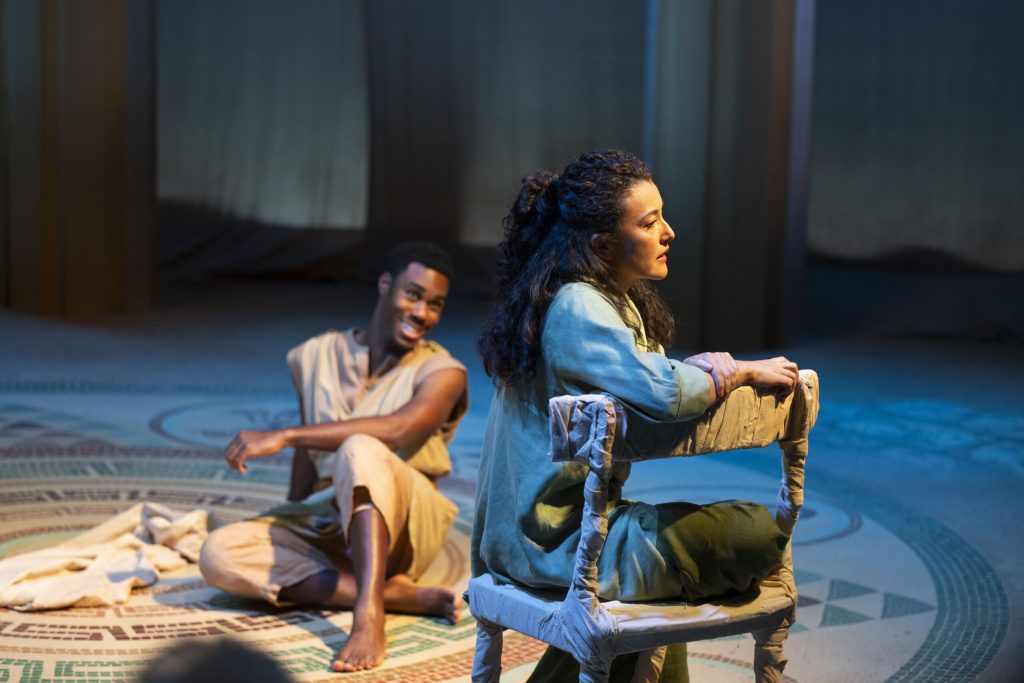
Attempting to leaven this production, humour – mostly in the form of contemporary dialogue – is used through this production. “What the fuck”, says Creon. “You’re fucking kidding me.” “I’m pretty sure I’m coming down with the flu”. Ismene (Kate Besworth) is portrayed as a flake. Haemon (Cameron Grant) is a lovestruck goof. On the other hand, much of Sophocles lyricism remains – especially in the words of the Chorus. But the humour fell flat for me and simply undercut the spare elegance of this great tragedy.
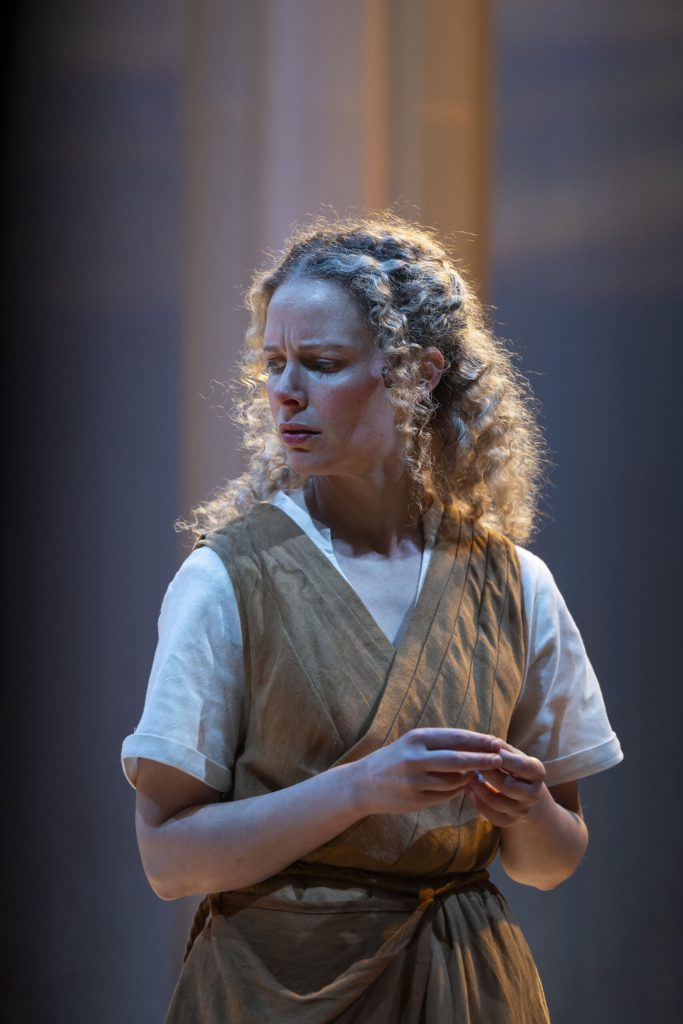
Paul Moniz de Sá is big and loud and proud as Creon; Jennifer Lines is affecting as Jocasta (who does not appear at all in the original text); with the exception of Yosie Bancroft (as Antigone), all performers double – donning half-masks – as the Chorus and the choral work is excellent.
Bancroft’s Antigone is full of shame-fueled rage which brings up the backstory: Oedipus, her father, was abandoned as an infant by his parents King Laius and Queen Jocasta because it has been prophesied that he will kill his father and marry his mother. Oedipus is raised by a couple who take pity on the poor babe whom they find with his ankles tethered. (Oedipus = “swollen ankles”). Years later, Oedipus falls into a road rage and kills the driver of the offending chariot and subsequently marries that man’s wife. He doesn’t find out for years that he has killed his father, married his mother and sired Eteocles, Polynices, Ismene and Antigone. Hence, the enduring family shame.
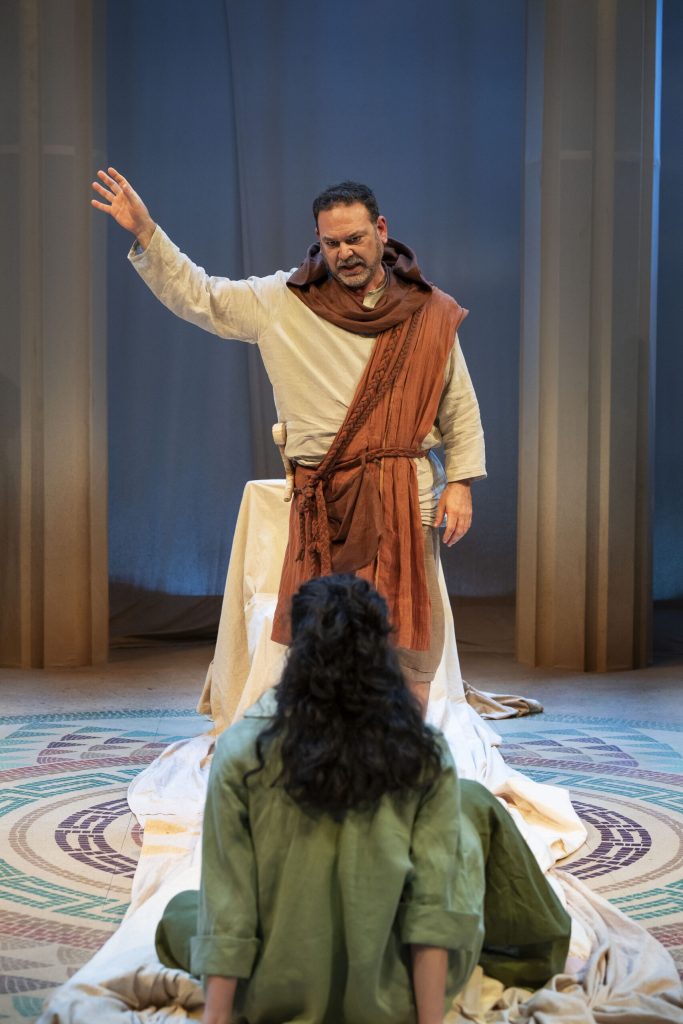
My response to this production would be quite different had I never read the original text. And it leads me to thinking about how theatre makers use ancient texts to reflect the contemporary world; this production is definitely a feminist take on Sophocles – Creon refuses to be bested by a woman – and I don’t deny Besworth and Hudson’s right to adapt as they see fit.
My disappointment aside, I urge you to see it. How often do you get the chance to see a play that has survived more than a couple of thousand years and is still able to reduce audiences to tears? Or that prompts an old critic like me to dust off the dog-eared Penguin classic and reread Antigone? Take a hankie to be on the safe side.