


The Cultch Historic Theatre to February 15, 2026
Tickets from $35 at 604-251-1363 or www.thecultch.com
Posted February 12, 2026
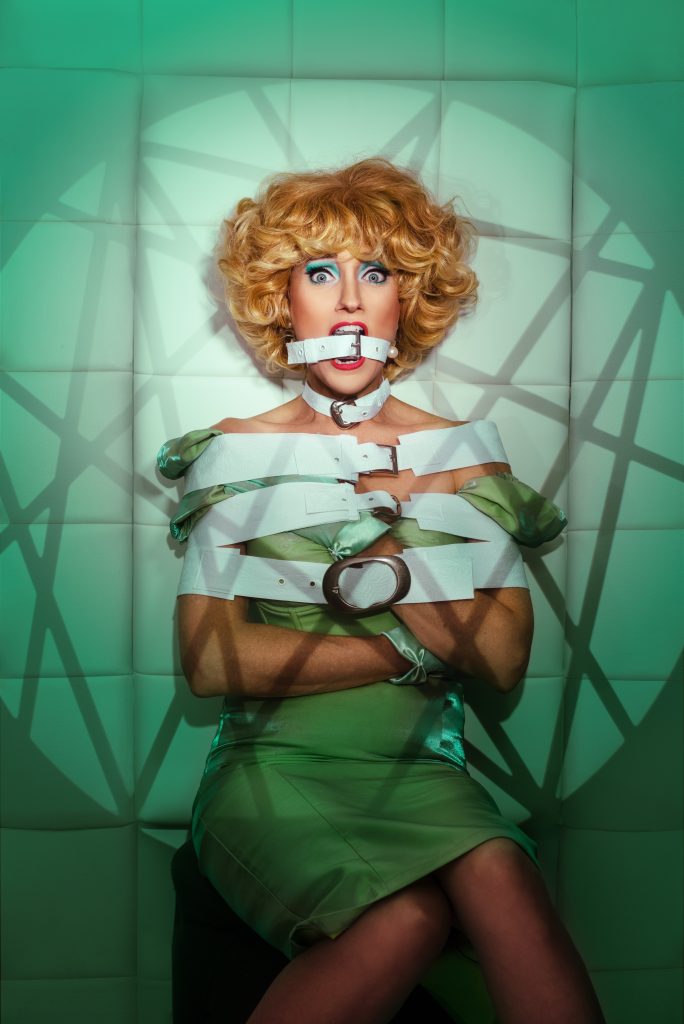
Created and performed by Leah Shelton, and produced by Shelton and Quiet Riot (Australia), BATSHIT will leave you praying that mental health issues are being handled significantly more effectively and compassionately than in the 1960s in Australia. This show – informative, entertaining, dynamically performed and stunningly designed – is a love letter to Shelton’s grandmother Gwen Eyre (1921-2001) who, at the age of forty-two, was admitted by her husband to Heathcote Hospital in Perth, Australia following her expressed desire to leave him. His rationale? Gwen had become “more difficult to live with”, after losing a newborn son eight hours after the baby was born. There was, as well, an ‘incident’ with the family’s TV.
Heathcote, always spoken about in hushed voices, was Perth’s mental health care facility; there, Gwen – without consent – was again and again and again administered electroconvulsive therapy (ECT) and a cocktail of drugs including Pentone and Brevipil. She eventually became “quiet and cooperative” but “withdrawn” and admitted that she was happiest “when not with her husband”, according to the hospital’s records which we see projected on the back wall.
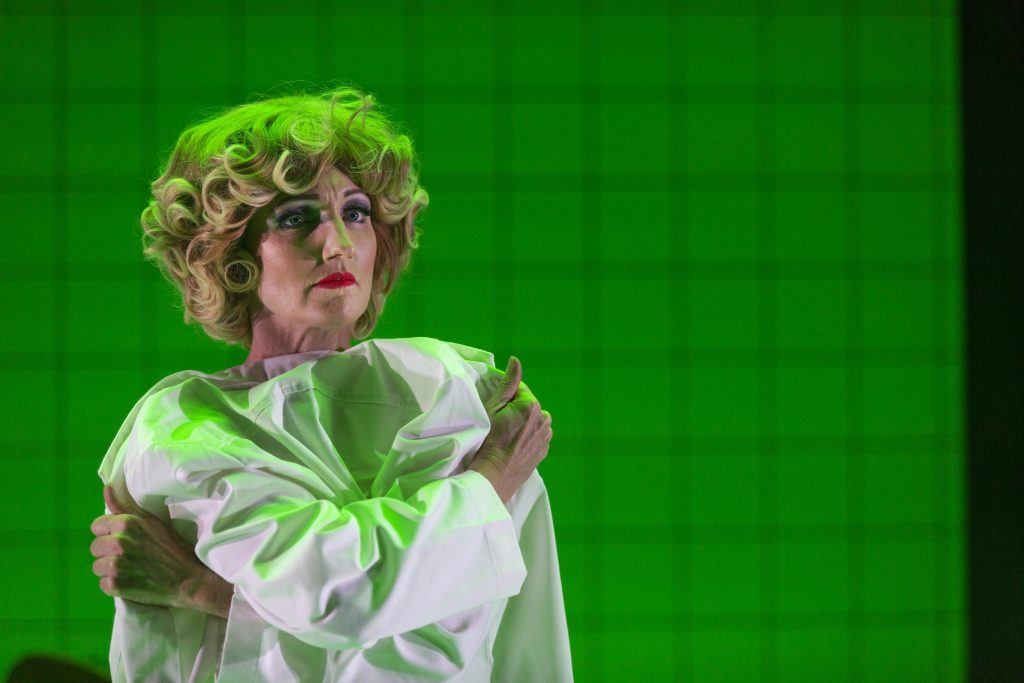
BATSHIT is a jewel of a show: written by Leah Shelton and Christine Shelton in collaboration with Ursula Martinez, and directed by Ursula Martinez, it’s fifty uninterrupted minutes of extraordinary creativity in performance and production. Lighting and sound by designers Jason Glenwright and Kenneth Lyons will have you jumping involuntarily out of your seat. Shelton herself is a live wire, first appearing in a frothy green gown and elbow length green gloves, shiny green stilettos, a curly blond wig and bearing an axe. What a show opener! And Shelton never lets up.
More than entertainment, there’s a lot of information passed along about the pathologizing of women’s frustration, anger and grief over their life experiences. From Shelton’s program notes: “Women are twice as likely to be diagnosed with depression, anxiety, panic disorder, phobias, suicidal ideation, suicide attempts, eating disorders and PTSD than men. Five times more likely to be diagnosed with borderline personality disorder. So it’s fair to say it’s a long-standing systemic problem.” In Gwen’s case, she had been living with her farmer husband, miles from anywhere, with few occasions for socializing, few friends. And then the loss of the baby.
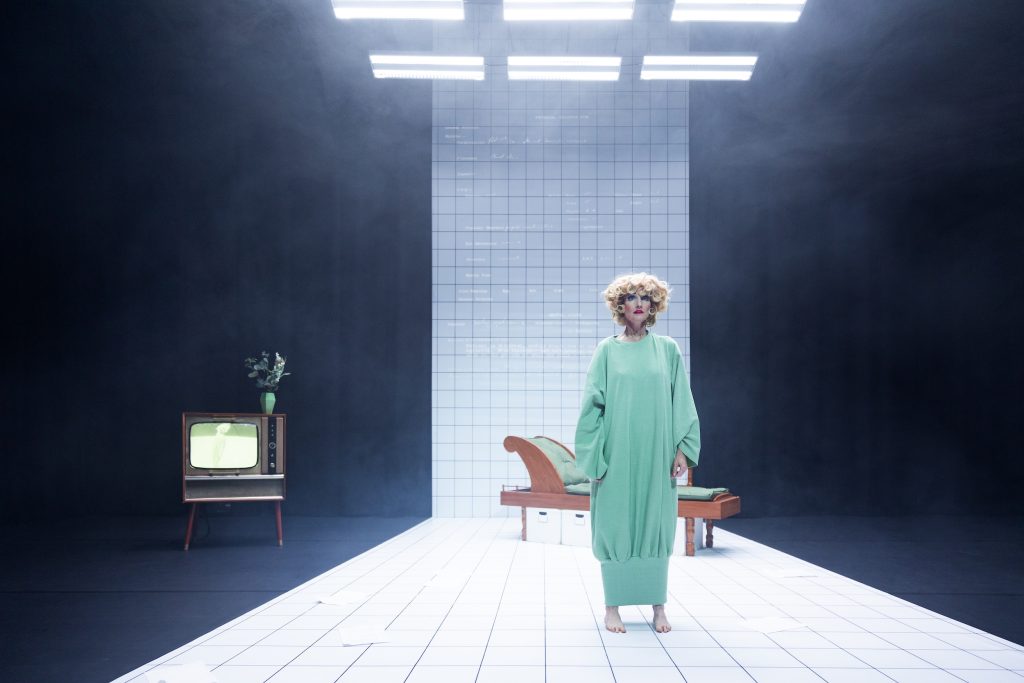
Amazingly, BATSHIT is never accusatory; rather, we are given the facts and left to draw our own conclusions. There is no hammering home, no heavy-handed diatribes. No melodrama. And humour, lots of humour: street interviews on a grainy black and white TV that asks passers-by whether they think Australian women lead “dull” lives; most of those interviewed said “no”, there was always “reading” and “gardening” and “shopping” to entertain them.
In a white lab coat, posing as a mental health care professional, Shelton wanders through the audience asking questions like, “Do you know what day it is?” or “What time is it” or “Are you lonely?” – questions that would routinely be asked on admission to a psych ward. Chillingly ordinary questions. And when asked, no one in the audience could come up with a male equivalent of “crazy bitch.”
No one could predict that BATSHIT would open the day after the shootings at Tumbler Ridge that raise all sorts of questions. How much more aware are we now of those among us who are seriously, perhaps dangerously, troubled? How then do we proceed? How capable are we of behaving more compassionately towards those that we see as ‘different’, or ‘other’?
The show continues at breathtaking speed and ends with a bang, not a whimper.
After the show, I asked Shelton how her grandmother fared after she returned home and lived out the rest of her life. Gwen was quiet, apparently, and spent her time “gardening” and “looking after her family” until she died at the age of 80.
A tribute to Shelton’s grandmother, BATSHIT celebrates the amazing resilience of a woman who suffered unspeakable abuse in the name of ‘care’ or ‘cure’.
BATSHIT IS part of the Cultch’s Warrior Festival which continues to March 29.