


Studio 16 to November 1, 2026
Tickets from $34.50 (students/seniors); $41.50 (adults) at www.mitchandmurrayproductions.com
Posted October 24, 2026
No one can write anything this personal, this intimate without first-hand experience and, indeed, American playwright Amy Herzog has that first-hand knowledge. Her child was born with a terrible neurological disorder and died at the age of eleven. Mary Jane is a play that is about as raw as it gets but its overwhelming impact is one of resilience, courage and – most of all – about the support women give to women. Ask any woman: the loving care we get from grandmothers, mothers, sisters, aunts and women friends when tragedy or misfortune strikes is what gets us through tough times. And, amazingly, we can still laugh. There’s some of that in Mary Jane, too.
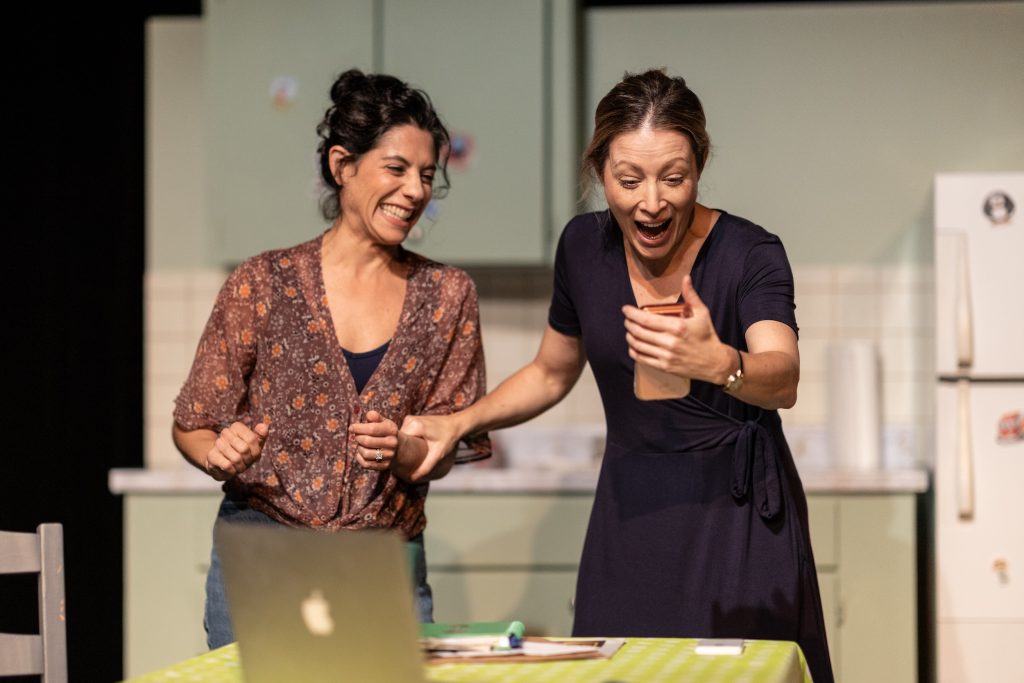
Mary Jane (Kate Craven) is a New York mom who has given up hopes of becoming a teacher to take care of her young son Alex, born prematurely at twenty-five weeks with cerebral palsy. We never see Alex but every moment of this play – and every moment of Mary Jane’s life – revolves around him. This is a real gut-puncher of a play, realistic right down to David Roberts’ set – the fridge, sink and cupboards of Mary Jane’s just-adequate Queens apartment. Mary Jane makes excuses for the long-gone husband, overwhelmed by the circumstances, leaving her to manage physically, emotionally and financially on her own. She bears him no grudges; life with Alex is going to be tough. Mary Jane cuts everyone some slack; that’s just the person she is. But as Alex’s condition deteriorates, it’s getting harder.

Enter the women in her life: Ruthie (Jennifer Clement), the apartment super who tries to unclog Mary Jane’s kitchen sink and suggests Mary Jane might want to take up tai chi because she’s “carrying a lot of tension” in her body; Sherry (Crystal Balint), the dedicated home-care nurse and her teenaged niece Amelia (Sewit Eden Haile); and Brianne (Advah Soudack), another young mom with a similarly-disabled child.
In Act 2 – seamless and without intermission – Alex has had a seizure and is now in hospital. Curtains are pulled and Mary Jane’s apartment is now a hospital waiting room. All performers except Craven take on different roles: Balint is now compassionate but pragmatic Dr. Toros, not about to downplay Alex’s prognosis; Soudack is a stoic Jewish mother of seven with a hospitalized child; Haile is Kat, a music therapist, who bends hospital rules to bring music to Alex; and Clement is Tenkei, a Buddhist nun, the hospital chaplain. In each case, the transitions have some common ground with the previous roles.

In Aaron Craven’s director’s notes, he says: “Directing it has been an honour thanks to a remarkable group of women: great actors, all about the work, bound by deep respect and genuine care for one another. They’ve lifted each other up at every turn, life imitating art…” And more than anything, this is what stands out about this production of Mary Jane. Not only do the women in the play lift each other up, but it is clear that these actors – in tackling this heart-wrenching material – are supporting each other in a tight, unified ensemble. As Mary Jane, Craven, particularly, has to know she has these actors fully holding on to her and she gets everything she needs from them. In Act 1, Craven’s Mary Jane is almost cheerful, endlessly forgiving, always helpful. But this upbeat attitude is just Mary Jane’s way of coping. By Act 2, while not giving into despair, Mary Jane struggles to remain optimistic and the actor is close to tears or actually crying. Clement, Balint, Soudack and Haile are there every step of the way for Craven.
Mary Jane, a Mitch and Murray Production, is not easy viewing but playwright Herzog wisely bookends it with building manager Ruthie (a no-nonsense gal with a big mouth and a big heart) and Tenkei (a shorn, former Episcopalian-turned-Buddhist nun) who sits ruminating with Mary Jane, now in hospital isolation garb, about the sex of a goldfish they see in a bowl. Both roles – Ruthie and Tenkei – are played by Jennifer Clement and she brings such quirky compassion to Ruthie and Tenkei that the play ends not sorrowfully but quietly and reflectively.